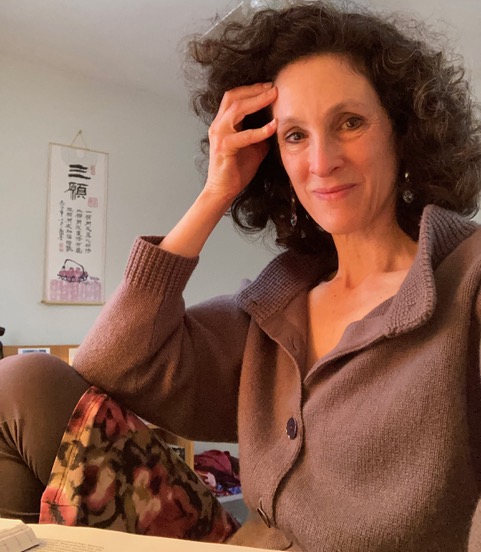
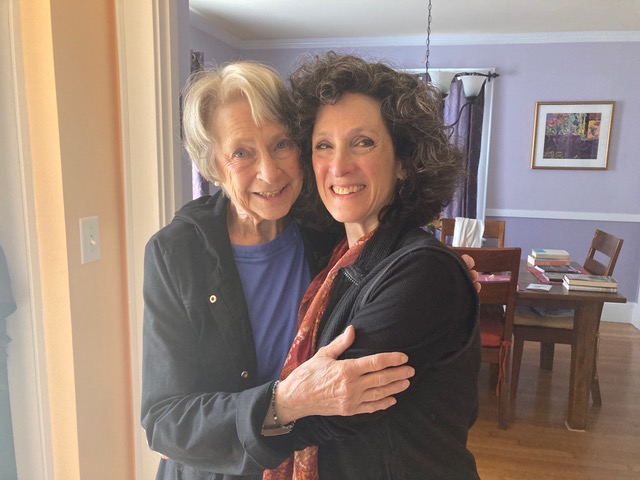
Issue 9’s Featured Writer and winner of Alphabet Box’s Anaïs Nin Prize is Carole Greenfield. After reading her bio, and work elsewhere, including her “Balanced Hearts” essay published by Amethyst Review, I found we have more in common than the pursuit of excellent writing — four of her poems are featured on Alphabet Box.
I also learned that Carole has a strong desire to help others by teaching, affirming, mentoring, tutoring and coaching them, whatever their ages and social status, so that they may write better… to express their thoughts and feelings in English.
It’s my privilege to congratulate and interview Carole Greenfield. — Stephen FitzGerald, Alphabet Box founder/editor.
Adolescence
You were born in the United States and raised in Colombia?
I was born in Boston, Massachusetts. My parents moved our family to , Colombia for a job opportunity when I was eight years old. I attended the rest of elementary school there, returned to Massachusetts for junior high school, and completed high school in Colombia before coming back for college.
Did young love inspire “Adolescence Overseas“?
In part, yes, but not primarily. The poem is an attempt to compile sensory memories of a particular time in my life, to capture many things that I felt passionately about in a country I loved, a place that remains in my memory as I experienced it during my adolescence.
Teaching
How long have you been teaching?
I started out teaching writing in 1992, when I worked with VOICES: Writers Teaching Writing, an organization based in the Raleigh, North Carolina area.
That work led me to offer writing workshops to adult ESL (English as a Second Language) students at community college, which gifted me with my love of working with ESL students of all ages and backgrounds.
I transitioned to teaching children after completing a Masters of Arts in teaching ESOL (English to Speakers of Other Languages) in 1997.
Writing has always been a part of my teaching, whether working with adults or children. It’s also my favorite kind of teaching. It’s my core belief that everyone has a story to tell, that everyone’s story matters, and that poetry is possible for anyone. I am grateful that I can support others in their writing, and be a witness as they explore aspects of their own story.
What are the challenges?
My greatest difficulty in teaching adults was probably trying to convince some of the residents of the Raleigh Rescue Mission that thinking critically was not a bad thing.
For me, the greatest challenge in teaching young people was, and is, learning effective classroom behavior management.
Wonderful things about teaching ESL adults and young people?
Most wonderful things about teaching adults? Too many to name. Here are three: 1) supporting and witnessing their creative ways of expressing their thoughts, feelings and stories in a new language, 2) helping them believe their lives and stories mattered, and 3) being inspired by their resilience, compassion and example.
With my younger students, what comes to mind is their ability to forgive, their sense of humor and playfulness, and their presence in the moment — it requires me to be present with them, which is a blessing.
Poetic warning
In the past five years or so, has your poetry evolved? Explain how or why.
Two things in particular have helped my poetry evolve since the pandemic. One has been taking online poetry classes with Alison Luterman. She exposed me to a wide variety of poets, both in terms of the readings she brought to each session, and the other participants in the class, and that helped my writing stretch in new directions. Alison’s encouragement, deep knowledge, compassion and ability to create and hold space have been invaluable in terms of helping me stretch my writing in new directions.
Another thing that has helped my poetry grow and change has been participating in the Stafford Challenge, which requires writers to write a poem a day for a year. I did it for the first time in 2025. I ended up having 30 poems accepted and published. It proved so successful, that I signed on for this year as well.
More than the publications, though, the benefit of the Stafford Challenge has been the commitment write every single day. Showing up that way has helped me get back in shape as a writer, and has developed my ability to be more open throughout my day to all kinds of inspiration sources. In fact, I have given friends and family members fair warning — anything and everything is a possible poem!
Do you always know where your first lines will take a piece?
I almost never know where my beginning lines are going to end up. That’s one of the things I love about writing poetry, trusting the process and not trying to control where it will take me.
Examples?
Recent examples of poems that surprised me by their endings are “How I Know He Loves Me“ and “Weighted” (click then scroll to near page-bottom) and “River.“
Was there a time when you stopped writing?
I can’t remember a time when I completely stopped. There have been gaps of weeks and months between regular writing. I feel better when I’m writing regularly. It helps me get my self re-aligned.
I do remember telling myself, when I was deciding between a Masters of Arts in teaching or an MFA in poetry, that the only way I’d stop being a writer was if I stopped writing. So I didn’t stop.
Angels
Tell me about “Temporary Angels“
I was diagnosed with osteoporosis last year. I’ve had to make some changes in how I move though my environment.
With this poem, I was trying to recall a time when I felt embraced by the world around me, and also to remind myself that, even with loss, there are reasons to rejoice.
Directions
Where did it come from?
I wrote “Directions to Their First (and Last) House“ after reading Juan Felipe Herrera’s “Five Directions to My House.“ I had been tutoring a seventh grade student about writing poems, among other things. The prompt I gave her that evening was Write a poem with directions.
As I always do, I took on the same writing assignment I gave my student and wrote a first draft. This poem is what developed from that, a chance to ponder a heartbreaking period in my past and make some kind of peace with it. For me, that is one of the things poetry offers: a way to integrate loss and grief, and find my way back to a place of better balance..
First book
Your first book is titled Weathering Agents, I hadn’t heard the phrase before. 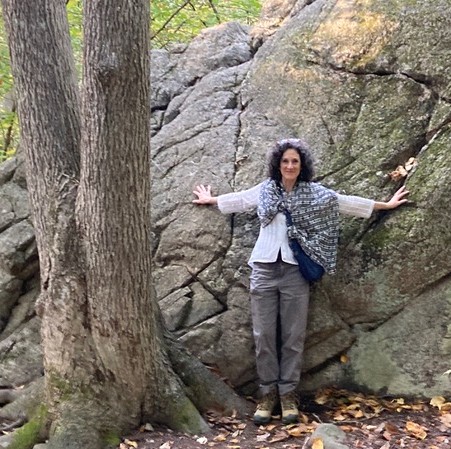 Briefly, I learned that weathering agents include water, ice, acids, salts, plants, animals, and temperature changes that contribute to the breakdown of rocks and minerals on the Earth’s surface. Why’d you choose this title?
Thank you for asking.
The genesis of Weathering Agents came from discovering the textbook Physical Geology by Carla M. Montgomery, when I worked at a research company in North Carolina for about a year and a half.
I had never studied geology, but something pulled me to that textbook on the shelf. From the moment I read its definition of cleavage — which is a contronym, by the way, a word that means two things that are the exact opposite of one another — it was clear to me that geological terms were perfect metaphors for passion, connection, love, desire, heartbreak, and beyond.
And when I encountered the term “weathering agents,” I knew that would be the title of the geology series that I would eventually create. As you know now, weathering agents are the forces that alter the surface of things on earth over time… to my way of thinking, they are also the ways that living and loving fully will change us — internally and externally — 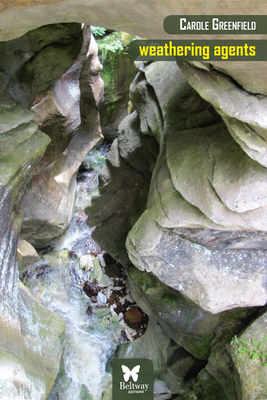 over the course of our lives.
I worked on geology-inspired poems for the following 25 years. I liked to say that I was working at glacial speed. My mother definitely thought so, as she kept asking me when I was going to finish “the geology series,” as we referred to it.
In February 2022, her cancer diagnosis prompted me to find a publisher, start submitting my poems online, and pulling together the collection, which I did by December of that year. Weathering Agents was released in March 2023, by Beltway Editions.
I’m thankful to be able to say that my mother is looking forward to my next poetry collection.
Snow Globes next
Tell us about it.
Snow Globes & the In Between is my first chapbook. It came about earlier this year, after unsuccessfully submitting a second full-length collection to different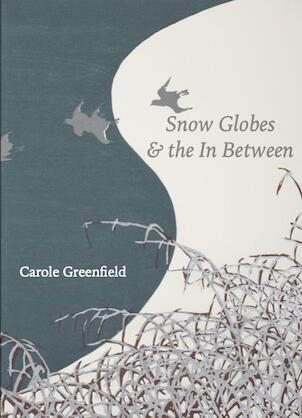 contests and publishers. I then decided to curate my poems into a smaller grouping, about 20, for a chapbook competition.
Selecting the poems for this endeavor was actually a delightful process. It made me slow down, it felt almost meditative. I wanted to arrange the poems as a love letter to those things that lift my heart — husband, parents, students, the small details of nature — all the people and things in my life that remind me not to give up.
A kind of sweet detail: earlier in the day that the chapbook was accepted, I had been walking home from the library and found a penny on the ground. Picking it up, I recited the old chant, “See a penny, pick it up, all the day you’ll have good luck.” When I got home and checked my email, there was an acceptance of the chapbook from Lost Penny Press.
Quick takes
Best writing advice you’ve received and from whom?
The best advice was from my friend Lucy Tatman, who wrote to me, “Write as if your life depends on it. Because it does.”
Your favorite snack or beverage while you’re writing, and when do you prefer to write?
Favorite snack: rice cakes. And tea. My favorite time to write is early morning.
All-time favorite books?
That’s like asking a teacher to pick a favorite student — not possible! But here are a few top contenders: Edith Wharton’s The Age of Innocence, E.M. Forster’s Howards End, and Pamela Brown’s The Swish of the Curtain.
Have you completed the Myers-Briggs personality-type questionnaire? If so, what’s your four-letter profile result?
Yes. The subject line of my first message to my future husband was, “INFP=me.”
Last question… If you were interviewing yourself, what question would you ask? And what’s your answer?
A question I might ask myself… Why do you believe poetry matters?
My response… Poetry matters because it’s a splendid reminder that we are not alone, that our experiences have been felt by others throughout the years, and other people’s poems can help us find language for our feelings about our experiences when we ourselves cannot find the words.
That’s our interview. Thank you, Carole, for your thoughtful answers and generous time.
You’re quite welcome. Thank you, Steve.
Click to read Carole Greenfield’s Anais Nin Prize-winning poems featured on Alphabet Box. We also invite you to visit her website, where autographed copies of her books are available… http://www.fieldsofgreen.us/carole/.
In addition to her collections of poetry, her work has appeared in Still Point Arts Quarterly, The Plentitudes, and many other publications.